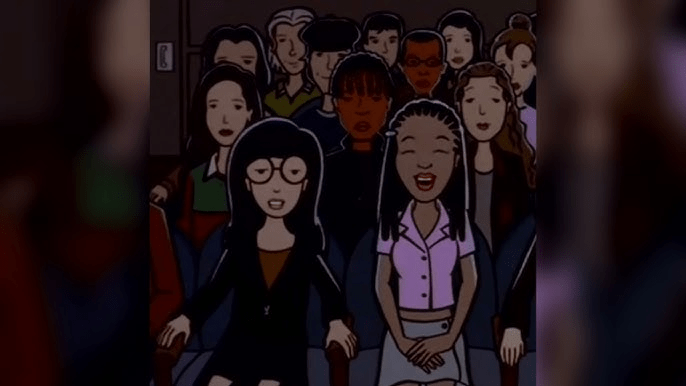
What would you do if you had a wee bit of free time and didn’t acknowledge any intellectual property laws? Would you, perhaps, sample Vanessa Carlton’s 2002 hit song “A Thousand Miles,” compress it into a freakish glob of sound, put a thrashing drum and bass (DnB) beat over it, mix in the most absurd soundbites you can find, call it “copyright strike my fucking nuts’’ and self-release it?
No, you wouldn’t. But obviously it exists because that’s way too specific an example for me to formulate on my own. Indeed, when leroy (now better known as Jane Remover) dropped the album “Dariacore” in May 2021, which included “copyright strike my fucking nuts” alongside other absolute bangers like “will work for food” and “go white enby go,” it made listeners question if they were in some kind of sick joke of a simulation.
Two minutes of “Dariacore” might kill a Victorian child, but for the rest of us listening in our hazmat suits, I’d feel safe calling the album a sonic treasure. And not even in the “it’s so bad that it’s good” way; this album is brilliant beyond the fact that the whole thing is totally unserious. Explosive and self-aware, “Dariacore” finds a way to elevate its source material while also showcasing its essential absurdity.
AS ONLINE AS IT GETS
While I’d like to believe that “Dariacore’’ simply manifested from the ether we call the internet, it actually sprouted from significant musical roots. The first major influence is song flipping, where artists will sample, change and thereby transform songs/sounds to an essentially different experience. This is a very general idea but worth acknowledging nonetheless, as leroy references song flipping’s traditions as a sort of musical language which can function as a system of inside jokes.
Accompanying leroy’s striking song flips are blaring jersey club, DnB and jungle beats, which all draw heavily from hip-hop, breakcore and electronic music. “copyright strike my fucking nuts” is an essential microcosm of what leroy does in other “Dariacore” tracks: the sped-up, compressed and chaotic reimagining of “A Thousand Miles” with a crashing DnB beat being emblematic of the album’s style. The key predecessors of “Dariacore” in this musical profile include EDM and nightcore, which also involve heavy sampling and breakbeat drums.
But while most song flips are serious sonic endeavors, “Dariacore” drowns in irony. The unserious quality of “Dariacore” seems to appropriate a history of online meme culture — YouTube poop (YTP) and SoundClowns in particular. For those unfamiliar, YTP consists of mashed up online media, cartoons and anime edited heavily and abrasively as to be humorous. SoundClowns are similar, mixing various sounds from the internet to make maddening Frankensteins of ironic music. “Dariacore” builds upon YTP, SoundClowns and general Gen Z humor quite well, employing a clever use of irony and a tight selection of sound bites to make the album incredibly fun to listen to… only if one knows what they’re listening to.
The two currents of song flipping and online meme culture combine to form the core qualities of the album’s method. But “Dariacore” is immensely more sophisticated than its predecessors, owing to how leroy plays with meaning, nostalgia and self-awareness.
REMIX, REUSE, RECYCLE
What “Dariacore” does to the brain is a kind of psychic phenomenon only comprehensible to the chronically online. To really enjoy or even comprehend the album’s experience, the listener would need to understand the album’s logic, which begins with the idea that “Dariacore” is not entirely original — its sounds come from somewhere. “Dariacore” is a mashup and remix album, with leroy’s instrumentals layered on. This has a few important implications.
For starters, mashup albums have samples. Sampled music has an interesting quality of being in constant dialogue with their source materials; sources can inform the listening of the sample and vice versa. Let’s take the example of “Money Trees” by Kendrick Lamar, which samples “Silver Soul” by Beach House. Some will listen to “Money Trees” and be like, “Holy crap! That’s that Beach House song!” which then can inform the listening of “Money Trees” by ascribing whatever past feelings they had of “Silver Soul” onto Kendrick’s beat. Conversely, some will listen to “Silver Soul” and be like, “OMG! Be the last one out to get this dough? NO WAY!”
Often, the sample-source relationship isn’t particularly impactful, usually resulting in either the source material or sample receiving more notoriety, depending on the context. But “Dariacore” as a remix album takes greater control of the sample-source relationship by heavily contorting the meaning of the source material. “Meaning” can be loosely defined as the way we associate ideas with experiences. These “ideas” can be emotions, cultural/personal significance or even other experiences. For example, watching “Phineas and Ferb” reminds me of my childhood, and that nostalgia can represent the meaning of “Phineas and Ferb” in my life. While meaning is often personal, we can still analyze meaning on a general level insofar as aspects of culture have, to some degree, universality.
So, when Kendrick samples Beach House, not only does he not alter the source material significantly, but “Money Trees” centers around Kendrick’s rapping, which establishes the actual meaning of the song. The meaning of “Silver Soul” is therefore more or less unaffected; it’s mostly used as the song’s sonic texture. “Dariacore” tracks use lyrics exclusively sampled from songs or internet videos, and borrow heavily from the source material’s instrumentals. The album doesn’t really offer meaning of its own. It instead alters the meaning of its source materials to fit the meaning leroy desires from it. Where “A Thousand Miles” might’ve been a childhood sing-along for many, leroy flips the song to a chaotic, screaming, mocking rager. The classic piano riff turns into a monstrous synth-like backbone for the beat, accompanied by booming guitars. And Carlton’s vocals turn chipmunk-like as leroy compresses them so atrociously as to be almost unrecognizable.
leroy’s other samples follow a similar fate. “A Thousand Miles” accompanies a range of other nostalgic hits including “Boyfriend” by Big Time Rush, “Colors” by Halsey, “Outside” by Calvin Harris and “Dessert” by Dawin. The target audience of “Dariacore” is made much more apparent when lining up the samples’ release dates, which typically fall between 2010–2016. The album clearly attempts to constellate the sounds of a Gen Z childhood, 2010s pop music and internet culture, that leroy recycles into absurd versions we could never imagine ourselves. Its references are really only accessible to those who speak the frenetic online language which seems so obviously universal to us, but previous generations look on with baffled condescension. It’s an album that proves its particularity without force and thrives in it, and that is a unique achievement for any artist. In no simpler terms does it say, “You really just had to be there to get it.”
REFRACTION
It might be a good time to announce that if “Dariacore” shocked you, it might kill you to find out that “Dariacore” is, in fact, a trilogy of albums. The original album is followed up by “Dariacore 2: Enter Here, Hell to the Left” and “Dariacore 3… At Least I Think That’s What It’s Called?” And if that was the fatal blow, you might turn in your grave to find out that there is an entire ecosystem of “Dariacore”-inspired music that spawned in the following years. I made a playlist if you’re interested.
But in the three years since its release, the “Dariacore” trend came and went. The swift emergence and decline of “Dariacore”-inspired music has been too quick for people to really even categorize what it is. While many of the artists put their music under the “Dariacore” tag, leroy herself has disputed the use of this label. Many actually prefer the term “hyperflip,” and I happen to like it better too. Though, the genre, as I would have it, is more a shared ethos rather than a sound.
Like white light through a prism, hyperflip, from leroy’s inauguration of the genre, has become a spectrum of thoughtful humor, astonishing composition and absolute shitpost. As hyperflip evolves at whatever pace it may today, its samples become increasingly recent, as they begin to grasp the current pop culture. Artists will even sample each other, presenting new layers of meta. All of this indicates that hyperflip has accelerated to a level so esoteric that comprehensibility is merely an afterthought to just producing music lush with cross-reference and lobotomy levels of sublime absurdity and surrealism. In short, hyperflip is a hell of a blast to listen to, whether one can manage to understand it all or not.
It’s easy to listen to “Dariacore” and believe leroy is making mockery of all of the songs she samples… which is probably true, but I believe it’s secretly quite the opposite. The album is an appreciation for a gone era of music that sounded sugary, electric and ripe for reinterpretation. It feels like a longing for the tunes that played when times were simpler. leroy helps us escape, not by romanticizing things not decadent, but by collapsing our present absurdity with the unmistakable meanings, good or bad, of our shared pasts. We laugh at the tracks because they are stupid, and “Dariacore” is well aware of that fact. But stupid is meaning I can settle for.
 WNUR Wavelength