
By Kelly Rappaport
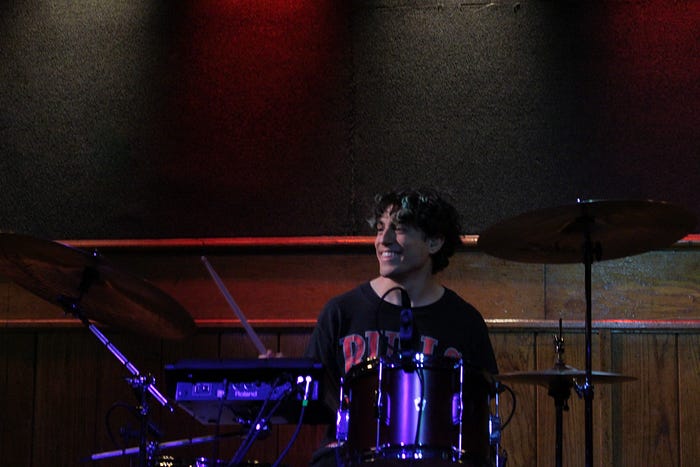
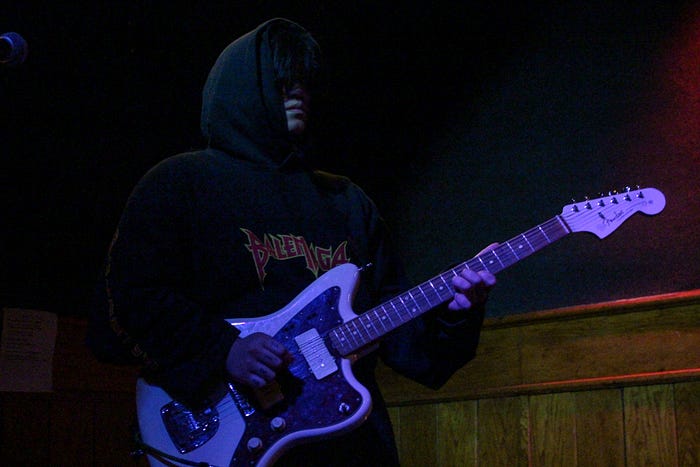
Brothers Christian, 24, and Louie, 23, Baello make up the production and bass/vocals respectively for alt-rock band Dream, Ivory. While their first self-titled EP released in 2017, their sophomore album About a Boy dropped in 2022 with a completely different sound — mostly attributed to age, experience, and more developed production skills. WNUR Media reporter Kelly Rappaport spoke with them about the creative process, their latest album, and the difficulties of being a musician. Dream, Ivory performed on March 23 at Schuba’s Tavern in Chicago.
This conversation has been edited for length and clarity.
Kelly Rappaport: Can you explain in more detail what roles you play and how you work on a song?
Louie Baello: Like when I said I’m primarily bassist and singer, sometimes Chris actually will play bass on a couple songs, and in our new album About a Boy he has a couple songs where he sang, played bass, and guitar so it differs based on the song we’re working on at a specific time.
Christian Baello: Since we don’t live together anymore, it’s primarily through FaceTime, email, Discord. We’ll just send ideas back and forth, sometimes Louie will start an idea or I’ll start an idea and then we just bounce off each other in that way.
KR: I know, Christian, you’ve done some other work producing as Ginseng, you’ve done some work with bigger artists; how did you fall into the production end, and Louie, how did you fall into the vocal/bassist end? I’ve read in some interviews that you came together because Louie, you wanted to rap? Is that correct?
LB: Yeah, that’s exactly how it started.
CB: We realized making music is pretty fun and I just started producing legitimate beats and trying to get other people on them. In terms of the band, apart from rap we’ve always been listening to a bunch of other music so we just decided to see what we could do in a more serious headspace.
LB: And the transition to making original music, even when it was rap at first, was easier than it would be for the average person because we were also doing YouTube videos and making song covers so we had experience of using a DAW [Digital Audio Workstation] like GarageBand, and recording tracks with guitars and stuff. It was definitely gradual, but it felt natural, and by the time we did Dream, Ivory, it was something we should’ve been doing.
KR: What was the process like making your first self-titled EP, and how did that process differ for About a Boy?
LB: For starters, it was just crazy when we decided not only that we wanted to start Dream, Ivory but that we had to start it with an EP, but I feel like in a sense that that was the downfall of it. I know a lot of people like Self-Titled but I feel like in the end, it just was me and Chris so eager to finally put out our first songs we’ve ever made as a band that we — at least we think personally a lot of the songs are rushed. In comparison to About a Boy, which was supposed to be an album called Lost Dogs which was a completely different album with different songs that are scrapped that we still have in the vault. I feel like this album, we were just way more selective and we wanted to release stuff that we knew we actually liked in comparison to “let’s just put stuff out to have a catalog and get it out” type stuff.
CB: The self-titled was like, we had done “Bite Your Tongue” I think, that was the first song we ever made, and then we made “Blue” and then we did “Dream, Ivory” and “welcome and goodbye.” Once we had those, we were kind of in a rush to finish a whole project to put out just because we were eager, so we finished that way too quickly. We finished it in maybe two weeks or something. Then for About a Boy, we took our time, we took maybe a year and a half or something, and even apart from the songs we put out, we still have even more demos from that era of songwriting. I think we’re taking this a lot more seriously than we did.
KR: Can you explain the decision to move away from the first album’s more lo-fi, ambient sound and into this almost pop-punk, more punchy sound?
CB: I would say it wasn’t even deliberate, like it was years ago that we made the old stuff and I know people enjoy that era of songs from us but we don’t. It’s kind of just what we’re into energy-wise, what we’re listening to, we’re older now.
LB: A lot of it too is just solely our technical abilities as musicians, like Chris as a producer, we didn’t have nearly as much knowledge, so a lot of the things that people think are considered like the lo-fi elements is just us not being so versed, not knowing how to mix.
CB: It’s just natural evolution and what we’re interested in hearing and making. We’re already trying to conceptualize a project right now and it’s already gonna be different from About a Boy. I think our minds, like Louie and I’s, constantly are attracted to new things, and no album is ever gonna be the same.
KR: So you think Dream, Ivory is going to continue changing and evolving? Any predictions on what sound you might tackle next?
LB: I think for sure that Dream, Ivory is always going to be ever-changing because, for example, when I’m in my late 30s, I don’t think I’m gonna have nearly the same interests as I do right now. And if I still do love music as much as I do right now, whatever inspirations and whatever’s in my life and the mood of my life is gonna reflect in our music. I feel like in terms of sound, we have specific ideas but we kinda like the mysterious aspect of it where we don’t drop and then we just drop some shit.
KR: What inspired you to make the naked or stripped-down version of About a Boy?
CB: Dropping About a Boy, like the original version, obviously it was a lot different for fans of us. So the naked version kind of serves as our new stuff, but stripped back and kind of adjacent to what our old stuff sounded like, but just better mixed, better recorded, still in the same vein, and in vision of what we want to drop now, but kind of adjacent to our old stuff.
KR: Okay, so kind of like a middle ground between the old and the new.
CB: Yeah, exactly.
KR: What influences the visuals that accompany your work, like album covers and videos? How do those come together?
LB: Chris does all our graphic designs, like our flyers, our visuals, audiovisuals and stuff. But in terms of like the music videos, I think, why we have a specific sort of vision is because Chris and I are just kind of, like super specific about stuff like that. And if we work with videographers, we actually like to draw a mini storyboard of the ideas and have a rough outline, but we still give people creative freedom we kind of just submit it to them like, “This is kind of what the idea is, but feel free to work around it or give us suggestions.” And when you work with like-minded people, it’s easy to bounce off ideas and stuff, so I think it’s just like a mixture of having like a sick-ass team and just honestly Chris, because Chris is like the vision behind so much of Dream, Ivory honestly, production-wise, graphic-wise, design-wise.
CB: Yeah, I think just visually we tend to just post shit that’s blown-out or looks kind of shitty on purpose, and super vibrant and whatever. I don’t like when shit looks too professional. I usually just go on Photoshop and just like like, make everything look fucked up.
KR: What’s something challenging about Dream, Ivory? Is it a welcome challenge?
LB: I think the challenge of being an artist in general is kind of just having to understand that, for example, when we put out our first self titled projects, a lot of people actually weren’t really fucking with it. And we’re actually seeing the opposite of things that they do now, whereas people are looking back like, “Why don’t you make music like your old stuff?” Back then, people were like, “Oh, I think your music would be good. You just need to mix your voice, maybe make it heard a little more, make it more clear,” but nowadays people want that old sound. I feel like the challenge is just realizing that at the end of the day, you just have to really make whatever you want to make, and you can’t really just try to gauge whatever people want because once you start releasing stuff to accommodate what people want, it just doesn’t become true anymore. I’d rather release stuff and then maybe the reaction isn’t what it is but if it’s truly good shit, it’ll prevail in the future, we’ll see.

 WNUR Wavelength